Introduction
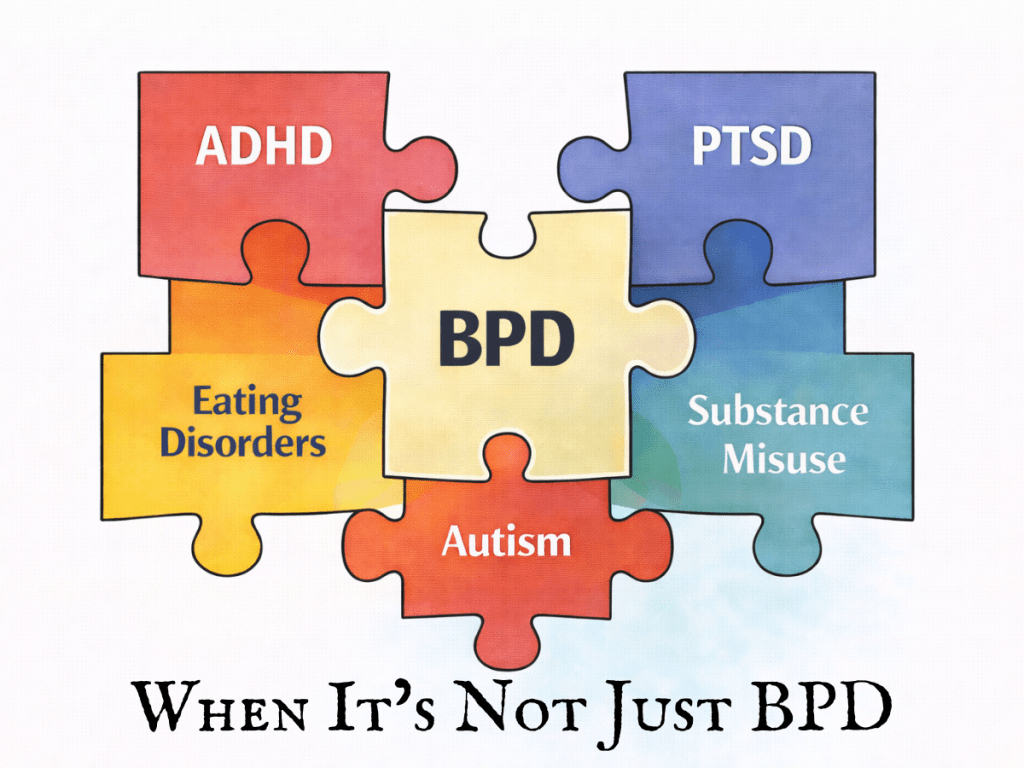
If you have borderline personality disorder (BPD), there’s a good chance other conditions are part of the picture too. That’s common: it’s having BPD and nothing else that’s relatively unusual.
This article summarises what we know (and don’t yet know) about comorbidity in BPD, and why it matters when you’re trying to get the right help.
How common are comorbidities?
One large American study suggests that 85% of people with BPD have at least one additional psychiatric diagnosis. Over a lifetime, most people with BPD will experience more than one other condition alongside it.
Commonly co‑occurring conditions include depression, anxiety disorders, post‑traumatic stress disorder (PTSD), attention‑deficit/hyperactivity disorder (ADHD), eating disorders, substance‑use disorders, and autism.
These conditions don’t just sit side by side. They can amplify each other, complicate diagnosis, and make treatment harder to access or sustain.
Why does this happen?
No one knows for sure, but a few well‑supported explanations are often discussed:
- Shared vulnerability (including genetics). Some people may inherit a higher baseline sensitivity to emotional dysregulation, impulsivity, anxiety, or mood instability.
- Trauma and chronic invalidation. Adverse experiences can increase risk for multiple mental health difficulties, including BPD traits.
- One condition can raise the risk of another. For example, untreated ADHD can lead to repeated failures, conflict, and shame, which may increase vulnerability to later difficulties.
The diagnostic puzzle
Mental health services often use categories and labels, to help decide treatment. And many people want a label to make sense of what they’re experiencing. But symptoms rarely fit neatly into one discrete box.
For example, difficulties with emotion regulation can be seen in BPD, ADHD, autism, bipolar disorder, trauma‑related conditions, and more.
In one study, 40% of people with BPD had previously been misdiagnosed with bipolar disorder – which suggests to me that the current labelling system faces huge challenges in correctly identifying what’s actually going on.
The latest NHS mental health report (APMS 23/24) made a point of highlighting the additional issue of diagnostic overshadowing: when having one diagnosis stops a clinician from investigating whether a behaviour may actually be caused by another condition. The same report also acknowledged that BPD can overlap with autism and complex PTSD.
Why the system struggles
In practice, support is often commissioned and organised around single diagnoses (for example, ADHD, autism, eating disorders, or in some areas personality disorder services). People with complex presentations can fall between services, or face eligibility rules that make it hard to get care that matches what they actually need. For example, personality disorder services often exclude people with active substance misuse.
NHS talking therapies are also generally time‑limited. Specialist treatments like Dialectical Behaviour Therapy (DBT), where available, vary in length depending on where you live, what is available and what is deemed suitable (from skills groups of 2 or 3 months to full programmes lasting roughly a year).
Transitions between child and adult services can be another weak point. For example, a young person with ADHD does not automatically transfer into adult ADHD care everywhere; reassessment waits can be long. During that gap, distress can escalate and additional problems can develop.
What does the research suggest about treatment?
Treating co‑occurring conditions can improve outcomes. For example, someone whose ADHD symptoms are effectively managed may find it easier to engage in therapy for BPD.
DBT was developed for chronic suicidality and BPD, but it has also been adapted and studied for related problems such as depression symptoms, eating‑disorder behaviours, and PTSD/trauma‑related presentations.
While DBT has evidence for treating multiple conditions, this doesn’t mean every DBT therapist is equipped to treat every condition. Finding someone with expertise across a specific combination of conditions can be genuinely difficult, and this gap isn’t always acknowledged.
What does this mean in practice?
If you’re seeking help for yourself, or for a loved one, it can help to keep these points in mind:
- BPD alongside other conditions is common. If things don’t add up, consider whether something is being missed.
- Choose your battles. Pushing for multiple assessments at once can be exhausting; it’s OK to prioritise.
- ‘Complex needs’ can feel vague, but it often reflects reality—and it usually means there isn’t a quick fix.
- If a short course of therapy hasn’t touched the surface, it doesn’t mean you’ve failed. It may mean the offer wasn’t matched to the level of need.
Conclusion
You’re not imagining it: ‘something else’ may be going on alongside BPD, and that’s common.
Complexity is hard—but understanding it can help you advocate for the right treatment for you or your loved one.
There is a growing understanding that BPD often comes with other conditions – and that treatment needs to reflect this. The frustration is that services haven’t caught up with this new understanding – yet.
