Tag: borderline personality disorder (BPD)

  • Bold Beautiful Borderline

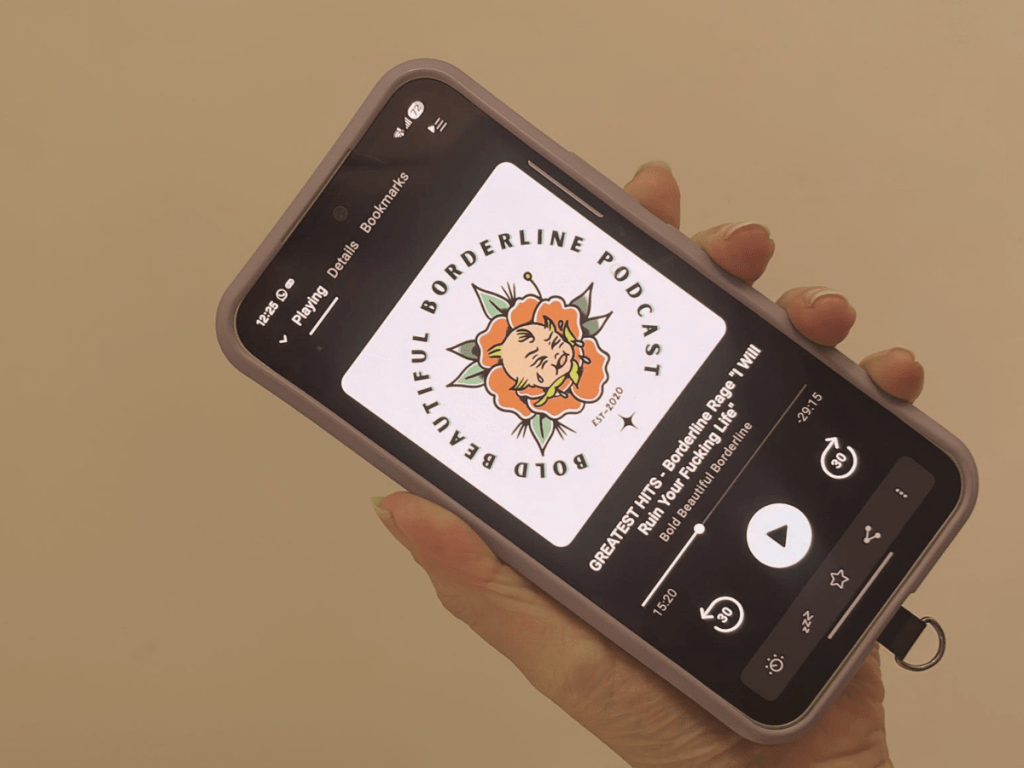
    Bold Beautiful Borderline

    PODCAST DETAILS

    Title: Bold Beautiful Borderline

    Host: Sara Abbott

    Platform/Availability: Spotify, Apple Podcasts, and all major podcast platforms

    Episode: Borderline Rage “I will ruin your fucking life”

    Year: re-released 7th December 2025

    Host background: Sara is a Licensed Clinical Social Worker with lived experience of BPD.

    1. WHY I CHOSE TO LISTEN TO THIS

    I decided to see if I could find some podcasts about BPD and this was one of the first to come up in the search. A therapist with lived experience is such a powerful combination and I was keen to tap into her wisdom.  

     I picked this recent re-release episode as a starting point because I find rage extremely challenging – both my own and other people’s. And my daughter experiences a lot of rage.

    2. WHAT IT COVERS

    Sara breaks down in detail a recent argument she had with her husband: what she was feeling and why, and how it was resolved. She then goes back and gives examples from her past of when she experienced rage and dealt with it less well. She reads out responses she had from people with BPD as to what rage feels like to them. She goes into some of the theory behind BPD rage, DBT skills and guidance for people who might be on the receiving end of it.

    3. STRENGTHS

    Sara is highly articulate and speaks passionately and with great clarity about her own experience and as a therapist. I loved the ‘case studies’ from her own life.

    4. LIMITATIONS

    FYI there is the occasional swear word – in case you’re thinking of listening to it in a public space!

    Sara does give some brief advice to people who are on the receiving end of BPD rage, but this isn’t the focus of the episode.

    5. TONE AND SENSITIVITY

    She describes her podcast as raw, honest and sometimes humorous and that’s what I got from this episode. She has great empathy for her listeners who have BPD – their strengths and their struggles.

    6. PERSONAL REFLECTION

    I think I’m going to re-listen to this episode as there was so much for me to digest. Listening to her journey – things she did when she experienced rage when she was younger, to how she handled it in this recent argument with her husband left me with hope. My daughter is working so hard in therapy, but it’s a long, slow haul and sometimes it’s hard to see the progress, so it’s heartening to hear from someone who has stuck with it and is now in such a different place.

    7. WHO IT IS FOR

    I think it’s primarily for people with lived experience of BPD, but as someone supporting a loved one with it I also found it really useful.

    8. STANDOUT QUOTE

    It’s OK to feel anger for longer periods of time, it’s OK for all of those things to live there, it’s just simply what we do with it.

    9. FINAL THOUGHTS

    This podcast is now on my subscribed list!

    LINKS

  • The Pecking Order of Distress

    The Pecking Order of Distress


    I keep thinking about a conversation we had earlier, dearest daughter. The one where I told you about the recent NHS survey suggesting that as many as 1 in 10 young women may have Borderline Personality Disorder (BPD).

    I’m not sure how I was expecting you to react – I think I hoped it would make you feel less alone. But your initial reaction was disbelief. You pointed out that you don’t see hordes of young women having episodes out in public — and surely you would, if there were really 10% young women out there with the condition.

    I got defensive

    I’d spent so long looking at the report, trying to understand what it was saying, how the screening for BPD worked, that you refusing to believe it felt like you were saying my article was wrong — even though I was just reporting the results.

    And I got that familiar feeling of frustration that has come from many years of me saying something and you automatically saying the opposite. Like disagreement is your reflex — even when I’m not arguing, just reporting.

    Athough, in this instance, I think you have a point. One in ten young women potentially having BPD does seem impossibly high. But even it’s an overestimate and the real number is closer to one in twelve, or one in fifteen, that’s still a huge number of people.

    Quiet suffering still counts?

    Wanting to defend the statistic, I suggested that maybe some had a different, quieter form. After all, there are many different “flavours” of BPD — not everyone explodes in public.

    You replied with your trademark bluntness: then they don’t really have a problem and shouldn’t count.

    TikTok and self-diagnosis

    You talked about TikTok and how frustrating you find it, seeing people doing posts, self-diagnosing themselves with serious mental health conditions like BPD — the “oh I get anxious and I wanted to kill myself once so I must have BPD” brigade.

    I can see why this would irritate you. The not understanding. The seeming desire to jump on a bandwagon. The undeserving taking a slice of your pie.

    But I also hate pecking orders of distress. The way people like to judge suffering and decide whether it is ‘better’ or ‘worse’ than an imaginary legion of others. It wouldn’t be so bad if these judgements were kept private, but they never are. People feel honour-bound to tell you your suffering isn’t as bad as someone else’s. You get put in your place — usually to shut you up.

    I say this because it’s definitely not just you who judges, I do it — we all do. It has been part of society since forever. Perhaps it’s worse now because of social media. I don’t know. What I do know is that it needs to stop. There has to be another way.

    A spectrum, not a tick box

    I reflected on this new way of thinking about personality disorder — how it is now to be seen as a spectrum, not a tick box. This new framework may be more accurate but I fear it will turn people’s suffering into one long pecking order of distress.

    Given that the NHS has limited resources, how will decisions be made as to whether you qualify for treatment for a personality disorder? How far down the continuum will you need to be? Will there be a magic algorithm that sifts through all the crisis team referrals and the hospitalisations and decides who is deserving? Not saying the system is any better now of course, but if the system is going to change, I’d like it to be for the better.

    TikTok and your diagnosis

    But then you talked about how TikTok was useful in your own journey to diagnosis.

    You were at college and struggling and saw all these videos where people were describing what they felt and did. They called it BPD and you thought they meant bipolar. But when you looked up bipolar specifically, you thought: this isn’t me. So you were confused, and you talked to me about it.

    I said BPD stands for Borderline Personality Disorder, not bipolar. That you having a BPD diagnosis was something I’d discussed with CAMHS a few years before, but they were reluctant to assess you at that age because emotional intensity and instability can look like ‘normal teenage’ stuff. But that maybe it was time to get you properly assessed – you were 19 at the time.

    So I found a psychiatrist privately. Things were so bad I didn’t want to wait months or possibly years to find this out. And hey presto, we’d both been correct. Or rather, the psychiatrist agreed with us. She diagnosed you as having BPD.

    Diluting the experience

    The other thing you said that gave me pause: you refused to believe the 1 in 10 statistic because if it was true, it would give people an excuse to treat it as less serious. Like the volume somehow diluted the severity of experience.

    And maybe what you were really reacting to wasn’t the statistic at all, but the risk that other people would use it against you. That they’d hear “mainstream” and translate it as: Not that bad. Not that urgent. Not worth resources.

    Bandages

    It made me think of the times we used to go to therapy after I adopted you. When we got ready for the journey home, you’d sometimes fake a fall and insist on bandages for an “injured” limb.

    Even when we all knew what you were doing, you still needed it. Because pain that can’t be seen has a habit of being doubted.

    Mental ill-health and trauma can feel brutally lonely for that reason: it’s invisible. And you found a clever way of making the invisible visible.

    You’ve fought so hard to get me — and others — to understand how serious your pain is. So I can see why anything that hints your suffering is now commonplace might feel like it’s pushing you back into being unseen.

    But what if….

    … there are hundreds of thousands of young women like you out there — suffering and not being understood?

    Maybe at the heart of this is a dialectical truth: you can be desperately unwell — and you can be one of many. Both things can be true at the same time.

    If 1 in 10 young women do have BPD, that statistic doesn’t make it trivial. It makes it very, very urgent.

  • A Dive Into The APMS

    A Dive Into The APMS

    The Adult Psychiatric Morbidity Survey (APMS) 2023/4 is a large NHS survey that gives a “snapshot” of adult mental health in England. It follows the same basic approach as the last APMS in 2014, so we can make some comparisons over time.

    The survey results were published at the end of 2025.

    This wasn’t an online poll. Researchers interviewed a random sample of adults in private households, and people answered the most sensitive questions privately on a laptop. Because it’s a household survey, it doesn’t include people living in settings like prisons or inpatient units, and it’s likely to under-represent people who aren’t in stable housing — all groups where mental illness rates are often higher.

    This post focuses on what the survey suggests about Borderline Personality Disorder (BPD).


    Boxes vs Spectrums

    The report notes that personality disorder diagnosis is changing. Older systems tried to put people into categories (like “BPD”), even though many people don’t fit neatly into one box. Newer thinking treats personality disorder more like a spectrum: traits become a “disorder” when they’re so intense or inflexible that they seriously disrupt everyday life and relationships.

    The APMS sits between the two approaches — it reports both category screens for BPD and antisocial personality disorder (ASPD), and a broader screen for general personality disorder traits.

    The report also notes a debate: critics worry a broad “general personality disorder” label could widen the net and increase stigma and pressure on services, while others argue personality disorder has been underdiagnosed and better recognition could improve care.


    What Screened Positive Means

    The APMS did not check people’s NHS records or diagnose them in clinic. It used questionnaires designed to work out if it’s likely someone has a condition like BPD.

    So these figures do not mean a confirmed diagnosis after a full assessment — they mean screened positive on a questionnaire.


    Key BPD Numbers

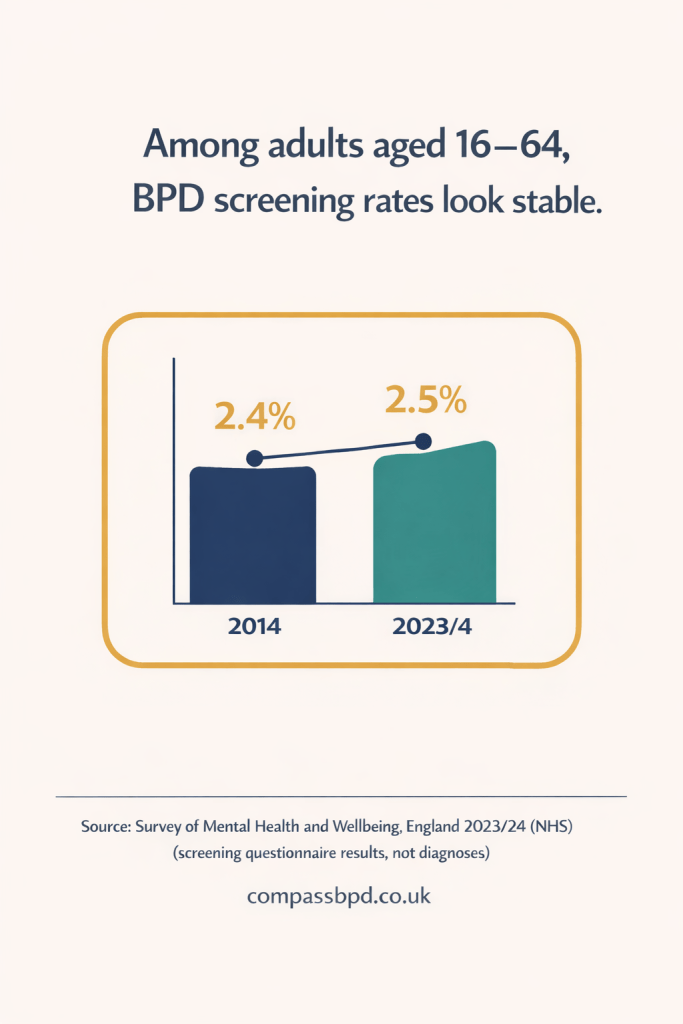
    • We can compare data regarding numbers who screened positive for BPD with data from 2014
    Bar chart comparing BPD screen-positive rates in adults aged 16–64: 2.4% in 2014 and 2.5% in 2023/4.
    BPD screening hasn’t budged much in a decade (16–64): 2.4% → 2.5%.
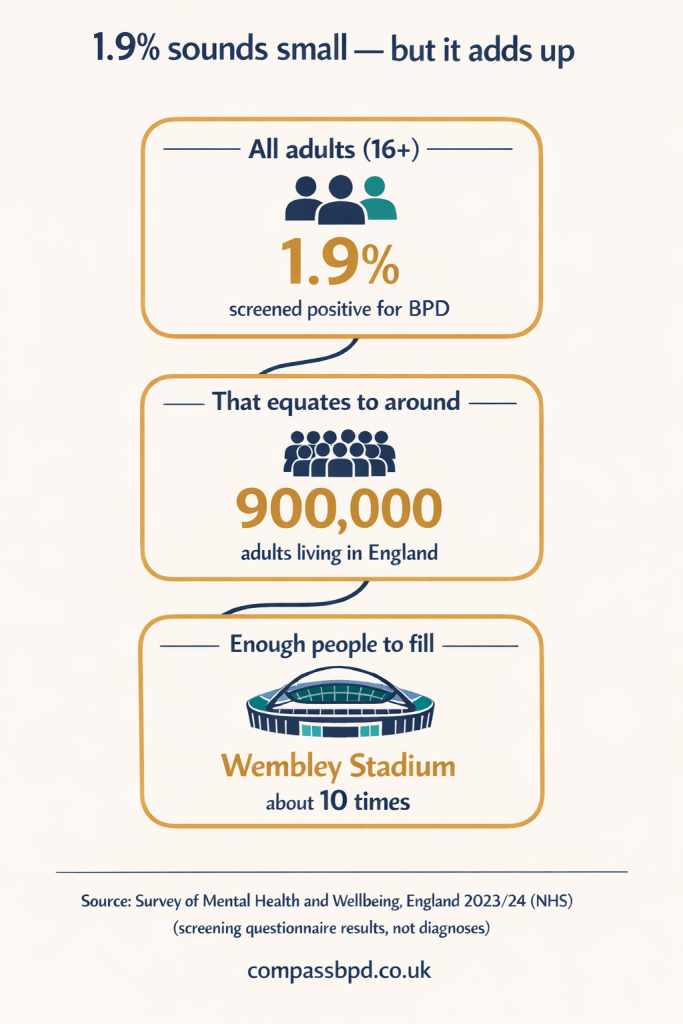
    • If you look at all adults 16 years and older, 1.9% screened positive for BPD
    Infographic showing 1.9% of adults aged 16+ screened positive for BPD, equating to around 900,000 adults in England (illustrated with people icons).
    1.9% sounds small — until you realise it’s about 900,000 adults in England.

    Young Women: A Standout Finding

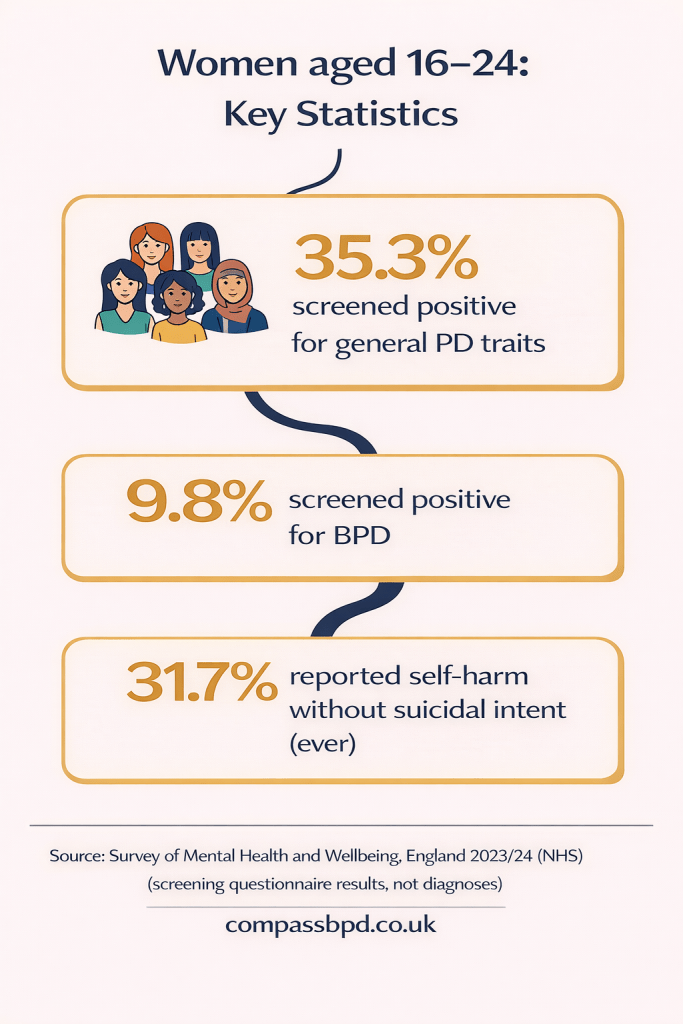
    One of the most striking sets of results is for women aged 16–24. They suggest that young women are experiencing personality disorder and self-harm (a common feature of BPD) at among the highest rates in the survey.

    Infographic listing women aged 16–24: 35.3% screened positive for general personality disorder traits, 9.8% screened positive for BPD, and 31.7% reported lifetime self-harm without suicidal intent.
    Young women (16–24) are the outlier: PD traits, BPD screening, and self-harm all spike.

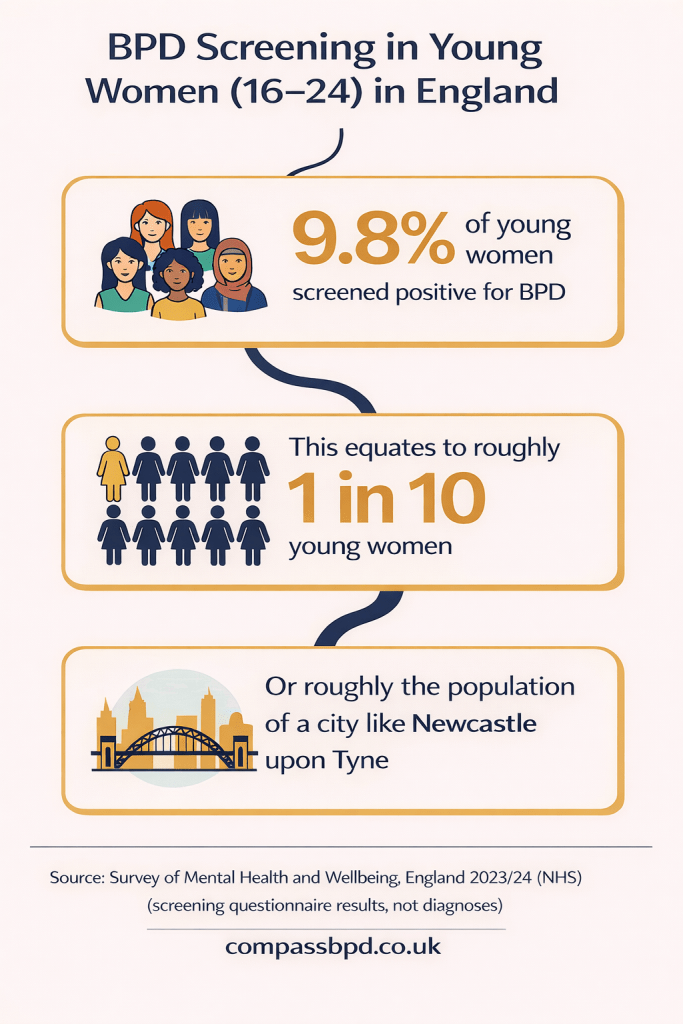
    The BPD statistic alone is cause for concern.

    Infographic stating that 9.8% of women aged 16–24 screened positive for BPD (approximately 1 in 10).
    About 1 in 10 young women (16–24) screen positive for BPD.

    The report also notes that some critics see “personality disorder” labels as a way of medicalising understandable responses to trauma, inequality, and social pressure.

    Are we diagnosing a biological disorder — or measuring the weight of modern society on young women?


    A Big Caution: Overlap And “Diagnostic Overshadowing”

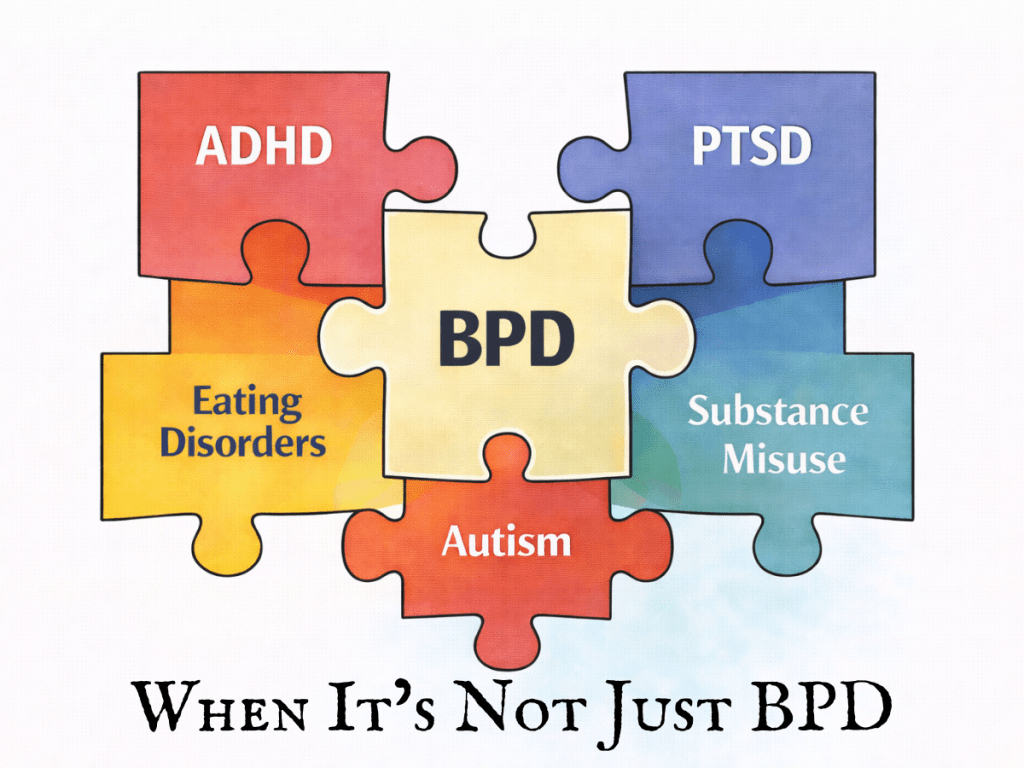
    The report points out that BPD and general PD criteria can overlap with autism and complex PTSD, which can contribute to “diagnostic overshadowing” (thinking a symptom is linked to one condition when it’s really caused by a different one).

    However, the report doesn’t publish a breakdown of any overlap between people who screened positive for BPD and autism or complex PTSD. Presumably because only 99 people in the survey screened positive for BPD, which limits how much detail you can reliably analyse.

    For me, this is a key area of concern. How can the right treatment be given, if we don’t fully understand what is causing the behaviour?


    The Soup Of Distress (What Tends To Cluster With PD Traits)

    What the report does show clearly is that people screening positive for general personality disorder traits are more likely to be facing wider pressures — including unemployment and financial hardship, and higher rates of depression/anxiety and limiting physical health conditions.


    The Treatment Gap: Pills vs Therapy

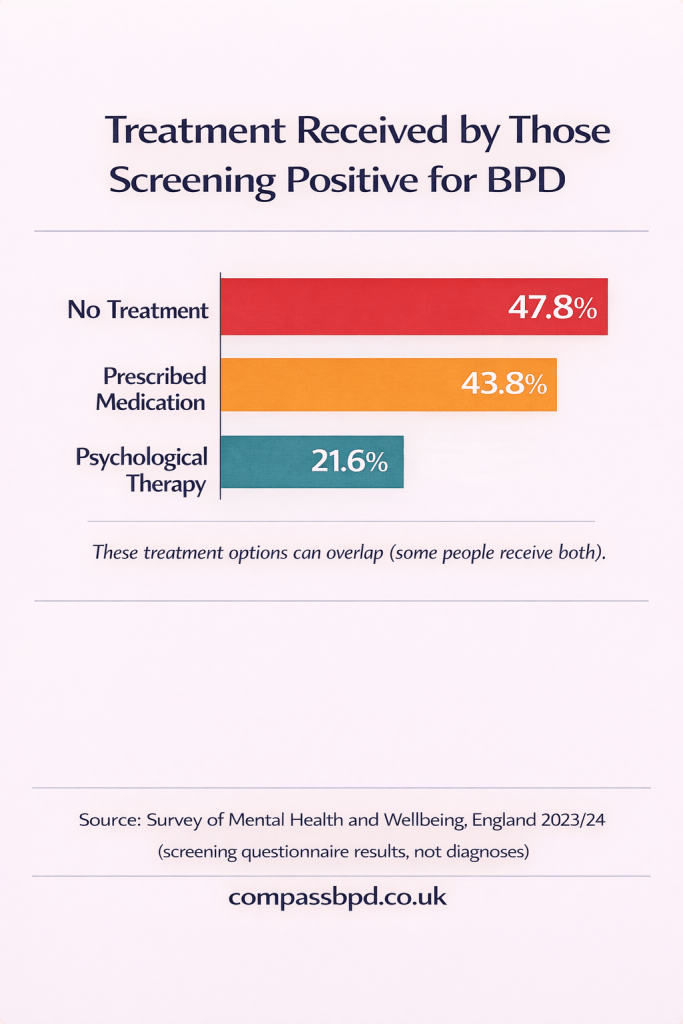
    The report suggests a mismatch between recommended care and what people report receiving.

    Horizontal bar chart for people screening positive for BPD: 47.8% reported no treatment, 43.8% reported medication, and 21.6% reported psychological therapy; note that treatments can overlap
    Nearly half get no treatment — and meds beat therapy by about 2 to 1.

    The report concludes this points to a need to improve treatment and service provision (while also noting the small BPD sample size means we should be careful about over-interpreting).


    One Hopeful Note – And One Hard Reality

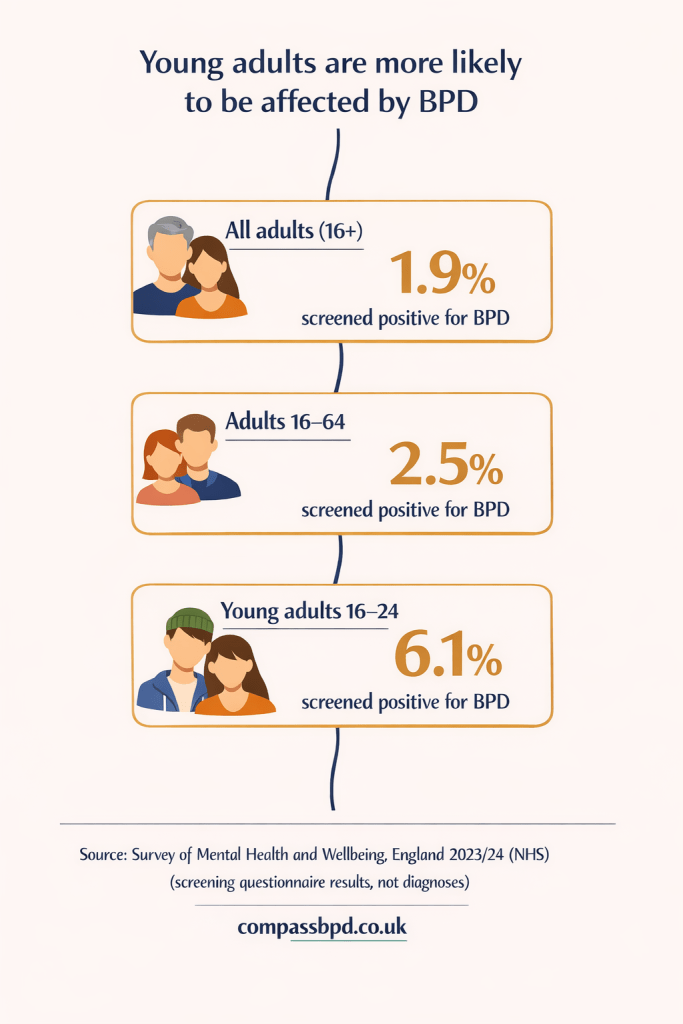
    A hopeful note is that the much lower screen-positive rates in older age groups challenge the idea that BPD symptoms must be lifelong for everyone (though the APMS can’t track individuals over time).

    Chart showing BPD screen-positive rates are highest in younger age groups and lower in older age groups.
    BPD screening peaks in young adulthood — then drops with age.

    But the report also notes that this isn’t a trivial condition. It cites earlier UK research in people treated by specialist NHS mental health services (beyond GP care) where life expectancy was estimated around 18 years shorter than the general population, and notes many were likely to have had a BPD diagnosis.

    Conclusions

    My conclusion is that it’s great to have this big-picture overview of mental health in England — but the survey now raises questions that need much more granular research.

    For example, my daughter has first-hand experience of diagnostic overshadowing: there are services for other conditions that won’t engage with her because she has a BPD diagnosis. That has been a major barrier to her getting better. The authors of this report suggest she isn’t the only one — but where is the data to confirm this pattern, measure its impact, and show what improves outcomes? Without clear evidence, it’s harder to push services to change.

    The figure of around 1 in 10 young women screening positive for BPD is a wake-up call. Even allowing for the limits of screening tools, this is too common to ignore. It should trigger urgent research into what’s happening for young women — and why.

    And the treatment picture won’t surprise anyone who has tried to access therapy for themselves or a loved one with BPD. It’s also not surprising that medication is used so often, even though there isn’t a drug that specifically treats BPD. When waiting lists are long and therapy is hard to access, people in crisis understandably want something — anything — that might ease their pain.

    Now that this report is out, the question is: will we treat these findings as a headline, or as a prompt for real change — better data, better access to psychological help, and fewer people falling through the cracks?

  • Handstands

    Handstands

    Trigger Point

    It was 8pm. We were on the sofa, watching television as usual. The dog crouched on the floor, quivering with excitement, waiting for you to throw his ball.

    Fleabag had just said I love you — and goodbye to the hot priest. A lovely end to a brilliant series. I said “all done” to the dog and walked out into the hall to put his ball away.

    When I came back, you were off the sofa and furious.

    The dog had ruined everything, you said. No — I had ruined everything. You’d wanted to do handstands. I’d ignored what you wanted, got the dog’s ball out instead, and now the moment had passed. You’d lost your motivation and it was all my fault, because I always put the dog first.

    You were getting louder and louder. I asked you to stop shouting. You said I only listened when you shouted. You’d asked me nicely to put the dog in his crate so you could do handstands, and I’d ignored you. Why should you make all that effort — keep trying with your DBT skills — if they didn’t even get you what you wanted? If I was going to carry on being so fucking useless?

    I stood there trying to catch up. It all felt like it had come out of nowhere, but it hadn’t.

    The Set Up

    It had started twenty minutes earlier, while you were still eating.

    Or maybe even earlier than that when I decided to eat without you. I was post-migraine hungry and couldn’t wait for your appetite to kick in. So I ate on the sofa alone.

    A Routine Disrupted

    Eating separately shifted the whole rhythm of the evening. It meant I’d already done the after dinner dog routine — ball throwing, kibble hiding, peanut-butter LickiMat — the routine we’d devised to try and put a limit on his relentless demands to play with us in the evening. The routine we usually did together.

    Then I was back on the sofa again, keeping you company while you ate your dinner. Sausages and mash, broccoli and green beans, everything swimming in gravy. One of your favourites.

    The Ask I Missed

    We were watching Fleabag when you said you wanted to do handstands, after you finished eating. These post-dinner handstands were a new thing. You said they gave you that strong feeling in your joints — like when you used to swing from the chin-up bar when you were little.

    You said, basically: he’s had his ball — put him in his crate so I can do handstands in peace.

    But I wasn’t so sure. The dog was staring, fully expecting the ball to appear again. And I wanted a quiet life — because when the dog got frantic, you shouted, I snapped back, and everything went to pot.

    I didn’t say any of that out loud. I just went to the kitchen and came back with the Nutella jar and a big spoon — your favourite pudding — and the dog’s ball.

    The Spiral

    You stared hard at me and silently flicked two middle fingers while you licked your Nutella spoon. I let it slide. I was focused on trying to please both of you: a quick play with the dog, then the handstands.

    Except the dog didn’t want to play with me. He kept delivering the ball to you.

    So I leaned over and picked it out of your lap, trying to save you the trouble of throwing it. You flinched as I got close. That stung, but I ignored it, not wanting to provoke you.

    Eventually I put the ball away. And then I came back to find you furious, and I got that familiar stomach-dropping feeling as your rage ramped up.

    Part of me was cross because it felt like it was over nothing — like I was being attacked out of nowhere.

    I told you I wasn’t a mind reader, and that if I’d known the handstand thing was time-critical, I would have handled the dog differently. You looped through your anger again: I should have known what you needed.

    As you raged I flipped between trying to defend myself and mutinous silence. Eventually I pushed back — telling you it was impossible to be open and reflective about my own actions while you were shouting at me.

    Lessons From Childhood

    You said this was no different from what had been expected of you at school — the teachers had shouted you into overwhelm, and then expected you to reflect on your behaviour and apologise.

    Hearing those words, my heart broke. I knew you’d been challenging at school, but no one should be treated like that, especially a child.

    You said it wasn’t just teachers. It was me too — I always made you apologise and rarely apologised myself.

    It was an uncomfortable truth. For all the stories I could tell myself about your “bad” behaviour, things usually escalated because I lost my temper.

    And then you looped back to the same old point: I never listened.

    The Repair

    You’d said it many times before — the not listening — and it always hit a nerve, because I did listen. I just didn’t always agree. But in a moment of inspiration, I tried something different. I asked if I could repeat back what I thought you’d told me, to check whether I’d understood. You could correct me if I’d got anything wrong.

    I said something like:

    So you were eating your dinner and you decided you wanted to do handstands when you finished. You could see that might be difficult with the dog jumping around, so you suggested putting him in his crate. I ignored that and got his ball instead. He kept bringing it back to you, and then I invaded your body space by leaning over to pick it up, which wound you up even more. And by the time I put the ball away, you’d lost the urge to do the handstands. That was frustrating because you’d genuinely wanted to practise. And it felt like I’d ignored you and put the dog’s needs before yours — and that wasn’t fair.

    As I said it, I could see — and feel — you calm down. And as you calmed, I felt myself shifting too. I could see it more from your point of view. I felt empathy for your frustration. I saw that little girl — taken into foster care — who’d never felt she’d been put first.

    I waited a moment then said that part of me still thought waiting could have worked — but I could see why it hadn’t for you. I was half-expecting you to explode again. You didn’t.

    See Me

    How quickly you calmed down surprised me. It gave me pause. I’d assumed it was obvious that I understood why you were angry, but it wasn’t. I’d already been moving on to the next thing — trying to solve the problem — when what you wanted first was to feel seen.

    You told me how frustrating it was when I looked away, or made what I thought were sympathetic noises while you were trying to explain how you felt. How it made you feel ignored — like I didn’t care or understand.

    I asked if I could do the repeating-back thing again in future — so I could check I’d understood, and you could feel me listening properly. You agreed it might work. It felt important.

    You suggested I write it up as a journal post.

  • Borderline Personality Disorder – What’s In A Name?

    Borderline Personality Disorder – What’s In A Name?

    A look at how one of the most misunderstood mental health diagnoses ended up with multiple names and why the language we use still matters.

    When I first started reading about BPD, I thought the name meant it wasn’t a very serious mental illness — that someone who had it was on the borderline of being mentally ill. Phew, I remember thinking, if that’s what my daughter has, it doesn’t sound too bad.

    It soon became clear that it was, in fact, a serious and complex condition. And the confusion deepened when I realised that it’s also called Emotionally Unstable Personality Disorder (EUPD) in some places. Other names cropped up too — Emotional Intensity Disorder, Emotional Dysregulation Disorder — leaving me wondering: Why does this one condition have so many different names? 

    A Bit of History

    The term borderline was coined in 1938 by an American psychiatrist named Adolph Stern. He used it to describe patients he believed sat on the borderline between neurosis and psychosis. 

    At that time, mental illness was largely seen as falling into one of two camps: 

    • Psychosis — where people lost touch with reality, seeing or hearing things that weren’t real and often requiring hospital care. 
    • Neurosis — conditions such as anxiety or depression, which could be treated through psychoanalysis. 

    Stern realised he had patients who didn’t fit neatly into either category. When distressed, they could temporarily lose touch with reality, but most of the time they weren’t psychotic. They were highly anxious, emotionally volatile, but often didn’t respond well to traditional psychoanalytic therapy. These were the people he described as being on the borderline

    How Mental Illnesses are Classified

    Agreeing on what to call diseases and symptoms has always been a challenge. The first International Classification of Diseases (ICD) was created in the 1890s to standardise how illnesses were recorded across countries. 

    Mental disorders were added in 1949, when the system came under the administration of the World Health Organization (WHO), which has managed it ever since. 

    A few years later, in 1952, the American Psychiatric Association produced its own manual — the Diagnostic and Statistical Manual of Mental Disorders (DSM) — based on the ICD’s classification of mental illness. Over time, however, the DSM evolved into its own separate system. 

    Although both systems still cross-reference one another, they now differ in the way some conditions are described and named. This is the main reason why mental illnesses can end up with multiple names.

    It’s also worth noting that while the DSM and ICD dominate psychiatric diagnosis globally, they’re not the only systems that exist. For example, China has its own manual — the Chinese Classification of Mental Disorders (CCMD). 

    A Bit More History – When Personality Disorders Entered the Picture

    As psychiatry moved away from thinking about mental illness purely in terms of psychosis and neurosis, both the ICD and the DSM introduced a new group of conditions called Personality Disorders. These described long-term patterns of behaviour and emotion that caused significant distress or difficulties in relationships and daily life.

    By the late 1960s, both manuals included a category for Emotionally Unstable Personality, but neither yet used the term borderline. Although it was being used out in the field – some influential psychiatric researchers had started repurposing this old psychoanalytic term and using it in their own work.

    Over time, the two manuals developed their own versions of the diagnosis: the DSM settled on the name Borderline Personality Disorder (BPD) in 1980, while the ICD updated its terminology in 1992 to Emotionally Unstable Personality Disorder, borderline type (EUPD).

    So What is it Currently Called in the UK?

    At the moment most UK clinicians still use the term Emotionally Unstable Personality Disorder (EUPD) but this is changing.

    The latest version of the International Classification of Diseases — ICD-11 — began rolling out internationally in 2022 and is gradually being adopted across the NHS. In this new version, the old term Emotionally Unstable Personality Disorder (EUPD) has been replaced by “Personality Disorder,” rated by severity (mild, moderate, or severe) with an optional trait description.

    This means the language in clinical notes will eventually shift from EUPD to something like:

    “Personality Disorder, moderate severity, with borderline pattern.”

    The transition to ICD-11 will take some time. It’s expected to replace ICD-10 in England over the next few years. Scotland has already begun using ICD-11 in some mental health settings, while Wales and Northern Ireland look like they are still in the planning stages.

    No Wonder It’s Confusing

    If you live in the UK, this can all feel like a right mess. If you go to your GP, they’ll probably use the term EUPD, because that’s the official language of ICD-10, still in use across most of the NHS.

    Over the next few years, as ICD-11 is implemented, this will change — most likely to simply “Personality Disorder (borderline pattern)” — though no national guidance has yet been issued.

    Meanwhile, my daughter calls it BPD, because that’s the term she sees on TikTok, where most of the content is made by American creators.

    UK charities such as Mind currently try to bridge the gap by saying:

    “Borderline personality disorder (BPD), also known as emotionally unstable personality disorder (EUPD).”

    Although this sort of description will presumably have to be updated now that the term EUPD is being phased out.

    Adding to the confusion, you might also come across terms like Emotional Intensity Disorder or Emotional Dysregulation Disorder. These aren’t official diagnoses in either the DSM or the ICD, but they’re used informally by some clinicians, advocates, and people with lived experience who feel the phrase “personality disorder” is stigmatising.

    The Problem with Personality Disorder

    For many people, the term personality disorder itself is painful. It can sound as though there’s something wrong with their core self, rather than describing how trauma, neurodiversity, or emotional dysregulation affect them. 

    The name can also carry stigma and people often report feeling judged or dismissed once that label appears in their records. 

    The Problem with Borderline

    It’s essentially a legacy label, a term that comes from a time when mental illness was understood very differently.

    When the DSM formally introduced Borderline Personality Disorder in 1980, it kept the word borderline simply because it had already been informally used for decades — and no one could agree on a better name.

    Today, it no longer refers to people being in a “borderline” state between anything. Now, clinicians use it as shorthand for a pattern of emotional and relational instability, but there’s nothing in the word itself that explains what it actually means.

    Further Reading

    If you’d like to explore more about how people feel about this diagnosis, I recommend the excellent report BPD Voices by CAPS Independent Advocacy. 

    It shares the wide range of feelings, experiences, and perspectives from people who have been diagnosed with BPD — including how they relate to (or reject) the label itself. 

    In Summary

    The story of BPD/EUPD is as much about language and culture as it is about psychiatry. 

    The name has shifted across decades, continents, and classification systems — and so has our understanding of what it means. 

    As more people with lived experience help shape the conversation, perhaps we’ll see new ways to describe this condition that are less blaming, more accurate, and more compassionate. 

    However, given that both the DSM and ICD tend to evolve slowly and conservatively I’m not expecting an official name change any time soon.

    Perhaps the best we can hope for in the short term is that a two-tier system gets created: one set of clinical terms used by professionals, and another set of names and descriptions used by people to explain their own experiences. Or will that just create even more confusion?

    Sources and Further Reading